Creative & Misc
Decoding Ancient Chinese Naval Warfare: A Tactical Infographic
by @GeekCatX
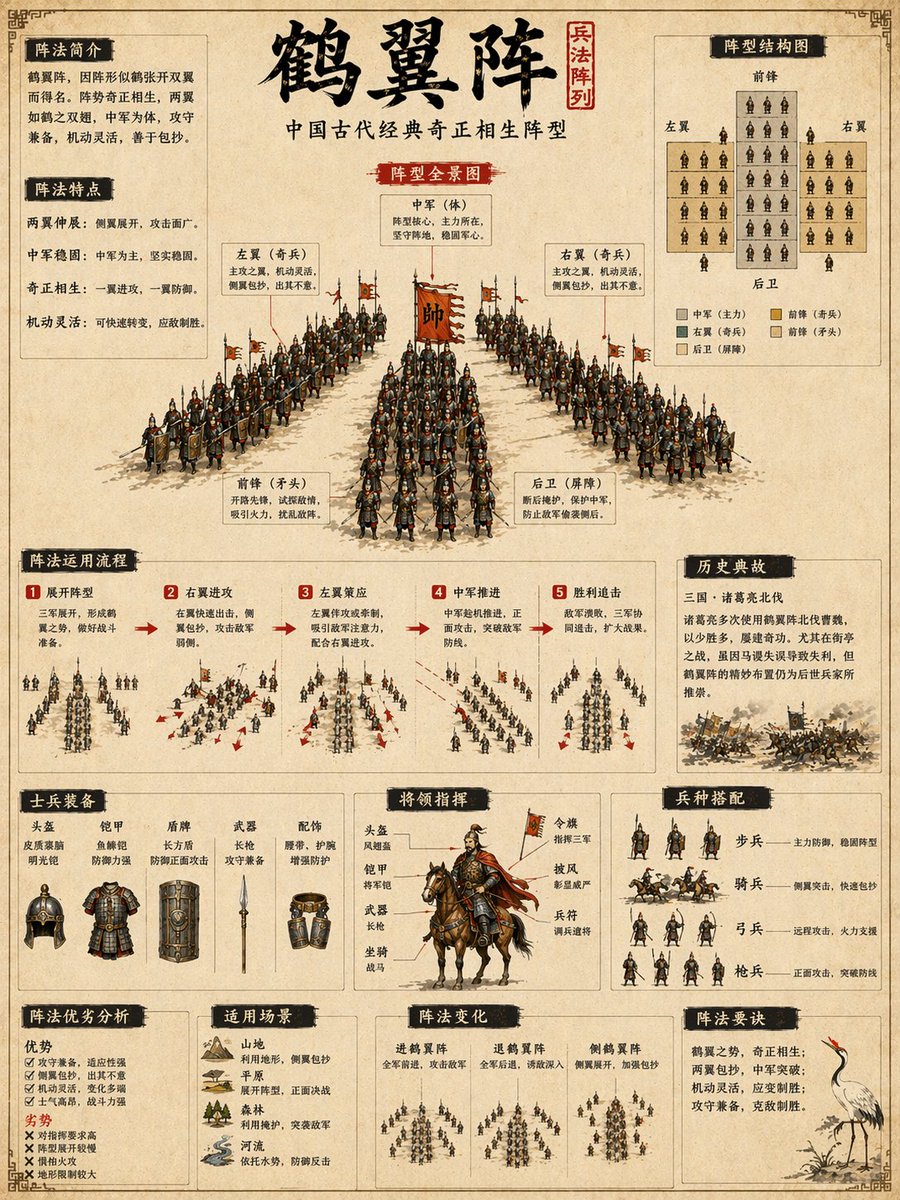
Full prompt (English — copy this into Studio)
COMPOSITION: [选择一个: 主从卫星布局 / 45度等轴测全景]. Information gravity flows in a logical tactical sequence.
BOUNDARIES: Professional editorial layout with clean margins; negative space serves as “tactical breathing room” to separate different combat phases.
MODULE TOPOLOGY: [N] distinct information modules depicting different scales (e.g., individual weapon detail vs. macro formation).

[DIMENSIONALITY & GRAPHIC PHYSICS]
STYLE: Fusion of Traditional Chinese Gongbi (meticulous line-art) and modern military tactical blueprints (like “Osprey Publishing” style).
LINE LANGUAGE: 0.8pt sharp technical outlines / 0.3pt faint background grid lines / 2pt bold borders for the main title seal.
SURFACE EFFECTS: Realistic material rendering — wood grain on ballistas, metallic sheen on lamellar armor, and subtle ink-wash shading for terrain.

[TYPOGRAPHY ECOSYSTEM — ADAPTIVE DENSITY]
TYPOGRAPHY DENSITY: Map-dominant (65% visual / 35% text).
T1 MACRO HEADER: Massive, ultra-bold Traditional Songti characters for the main title “[主题中文名]”. MUST be strictly pure Chinese Hanzi with an ink-pressed texture.
T2 MODULE HEADERS: Kaiti font enclosed in dark rectangular “military rank” badges, labeling different tactical zones.
T3 BODY TEXT: Clean, medium-weight Heiti (sans-serif) for weapon specifications and tactical roles. Every character must be razor-sharp.
T4 ANNOTATIONS: Micro-text with ultra-crisp technical lines pointing directly to components (e.g., trigger mechanism, fletching, armor joints).

[NARRATIVE FLOW]
NARRATIVE MODE: [选择一个: 流程顺序型 / 核心辐射型].
VISUAL ENTRY POINT: The most significant tactical unit (e.g., the command chariot or the primary siege engine).
PATH MECHANISM: Numerical sequence (1, 2, 3…) or bold cinnabar-red arrows guiding the viewer through the battle logic.

[ICONOGRAPHY & METAPHOR]
ICON STYLE: Highly detailed historical pictograms for units (infantry, cavalry, archers).
CORE METAPHOR: Military order as a precise clockwork mechanism.
CONSISTENCY: All symbols must adhere to the [时期/王朝, 如: Tang Dynasty] military aesthetic.

[MODULE STRUCTURE — SUGGESTED BLOCKS]
[MOD 1: CENTER-PIECE] — The primary [Weapons/Formation] with an exploded-view detail showing internal mechanics.
[MOD 2: TACTICAL MAP] — Top-down schematic showing unit movement and line-of-fire.
[MOD 3: SOLDIER EQUIPMENT] — Close-up side-by-side comparison of offensive vs. defensive gear.
[MOD 4: LOGISTICS/STATISTICS] — Small icon-based charts showing range, weight, or troop density.

[FINAL EXECUTION LOCK]
Render as a single, ultra-detailed educational plate. All visual systems must be internally consistent with a professional museum archive aesthetic. Every pixel must serve the purpose of clarifying complex military history.
Resolution target: Maximum information density, print-ready encyclopedia quality.

主题:中国古代兵器图鉴 3:4 4k文字清晰可读